How Long Do Stink Bugs Live? Egg to Adult, Stage by Stage
About six to eight months in total, and almost all of that is spent as an adult. The egg stage runs from a few days to two weeks, the five nymph stages take roughly four to six weeks, and the adult that walks into your house in October can still be alive in April.
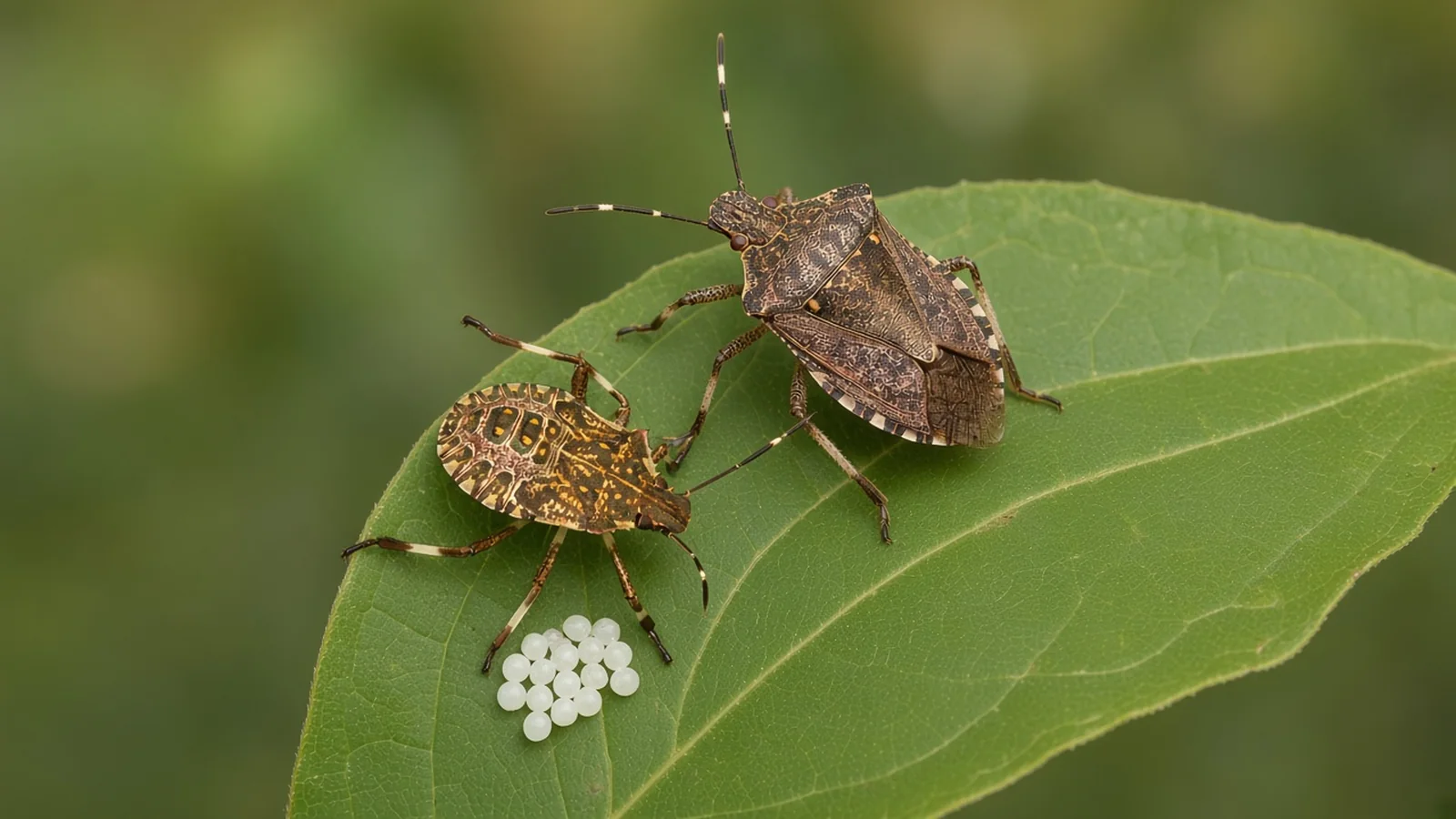
TL;DR
- Total lifespan: roughly six to eight months, egg to death, depending on species and weather.
- Egg: about 5 days to two weeks, in a cluster of roughly 20 to 30 on the underside of a leaf.
- Nymph: five stages over roughly four to six weeks, growing from about 2.4 mm to 12 mm.
- Adult: the rest — the ones that overwinter indoors are the long-lived ones.
- Indoors they do not feed or breed; they wait, and many do not survive to spring.
The short version
Terminix puts the average stink bug lifespan at about six to eight months and splits it into three stages: egg, nymph and adult. Penn State Extension and the Xerces Society fill in the calendar for the brown marmorated stink bug specifically: adults leave their overwintering sites from late April to mid-May, eggs are laid from May through August, and the new adults start hunting for a winter shelter from September into the first half of October.
Stage 1: the egg, 5 days to 2 weeks
Females lay barrel-shaped eggs in a tight cluster, side by side, usually on the underside of a leaf. Penn State Extension describes masses of 20 to 30 eggs; the Xerces Society gives about 28 per mass, with a female capable of laying up to ten masses in her life. Each egg is about 1.6 mm by 1.3 mm — small enough that a whole cluster fits on a thumbnail. Warm weather shortens the incubation, cool weather stretches it.
Stage 2: nymph, four to six weeks across five moults
Nymphs hatch out black and red with deep red eyes, and moult five times. Penn State Extension gives the sizes: 2.4 mm in the first stage up to 12 mm by the fifth. Terminix puts the whole nymph period at about four to six weeks. Nymphs cannot fly at any point in that period — wings only appear with the final moult, which is the simplest way to tell an adult from a nymph on your windowsill.
Stage 3: adult — and the overwintering trick
New adults emerge in late summer, feed hard on fruit and pods to build reserves, and then do the thing that makes this insect a household problem: from September they look for a dry, sheltered, cool spot to spend the winter. Tree bark outside, wall voids and attics inside. A bug that finds a good shelter in October can be alive and moving again in April, which is how a six-to-eight-month lifespan ends up covering most of a year on the calendar.
Penn State Extension notes this species usually manages one generation per year in Pennsylvania, with a second possible in a warm year — so the population you see is not doubling indoors over winter.
How long do they live indoors?
They do not settle in to live there. Stink bugs do not reproduce inside structures and do not feed on anything in a house — there is no fruit or sap in a living room. They find a crevice and wait out the cold, burning the reserves they built in autumn. Many do not make it to spring, and the ones that do leave or turn up half-dead on a windowsill in April. That is also why an indoor sighting in January is not evidence of an active infestation: it is a sleepy bug from October.
What actually kills them
Cold outdoors, running out of reserves, predators and parasitoids, and being vacuumed into a bag by a homeowner. There is no meaningful indoor breeding cycle to interrupt, so the useful question is not how to shorten their life but how to stop the next generation from choosing your wall. That is a caulk and screen job — the same one in the removal playbook — done before September.
More guides
Frequently asked questions
How long do stink bugs live?
About six to eight months from egg to death, according to Terminix, with most of that time spent as an adult. The ones that overwinter indoors are the longest-lived.
How long do stink bug eggs take to hatch?
Roughly five days to two weeks depending on temperature. Eggs are laid in clusters of about 20 to 30 on the underside of leaves.
How long is the nymph stage?
About four to six weeks, across five moults. Nymphs range from 2.4 mm at hatching to about 12 mm before the final moult.
Do stink bugs live through the winter?
Yes. Adults enter sheltered sites from September into October — tree bark, wall voids, attics — and emerge in late April to mid-May. Many do not survive, but enough do to restart the cycle.
Do stink bugs breed inside a house?
No. They do not reproduce indoors and do not feed indoors. An indoor bug in winter is sheltering, not nesting.