Stink Bugs in Florida: Year-Round or Seasonal?
Ask whether stink bugs are a Florida problem and the honest answer is: it depends where in the state you live. South Florida can push stink bug activity across most of the year, while north Florida shows the classic spring-vegetable and fall-invasion rhythm. This page looks at the species you actually meet in Florida, the two-peak calendar and the home plan that works in a warmer climate.
TL;DR
- Florida activity peaks twice: spring vegetable feeding and fall home-invasion pressure.
- South Florida can host stink bugs year-round; north Florida pauses only in the coldest weeks.
- Common Florida species: southern green, brown and green stink bugs, plus the invasive brown marmorated type spreading south.
- Exclusion — caulk, screens, sealed soffits — beats spraying in a humid climate.
Why Florida is a two-season stink bug state
The one-generation-fall-rush story that fits Michigan and Wisconsin does not fit most of Florida. In the southern half of the state, winter is a series of mild stretches rather than a hard stop, so stink bugs carry on feeding whenever it warms up. North Florida behaves more like the rest of the Southeast: a spring generation attacks vegetables as they set fruit, and the next generation builds into fall, when the first cool nights push adults toward sheltered house gaps. The practical result is that Florida residents often see the bugs twice a year, not once.
Species you will actually meet here
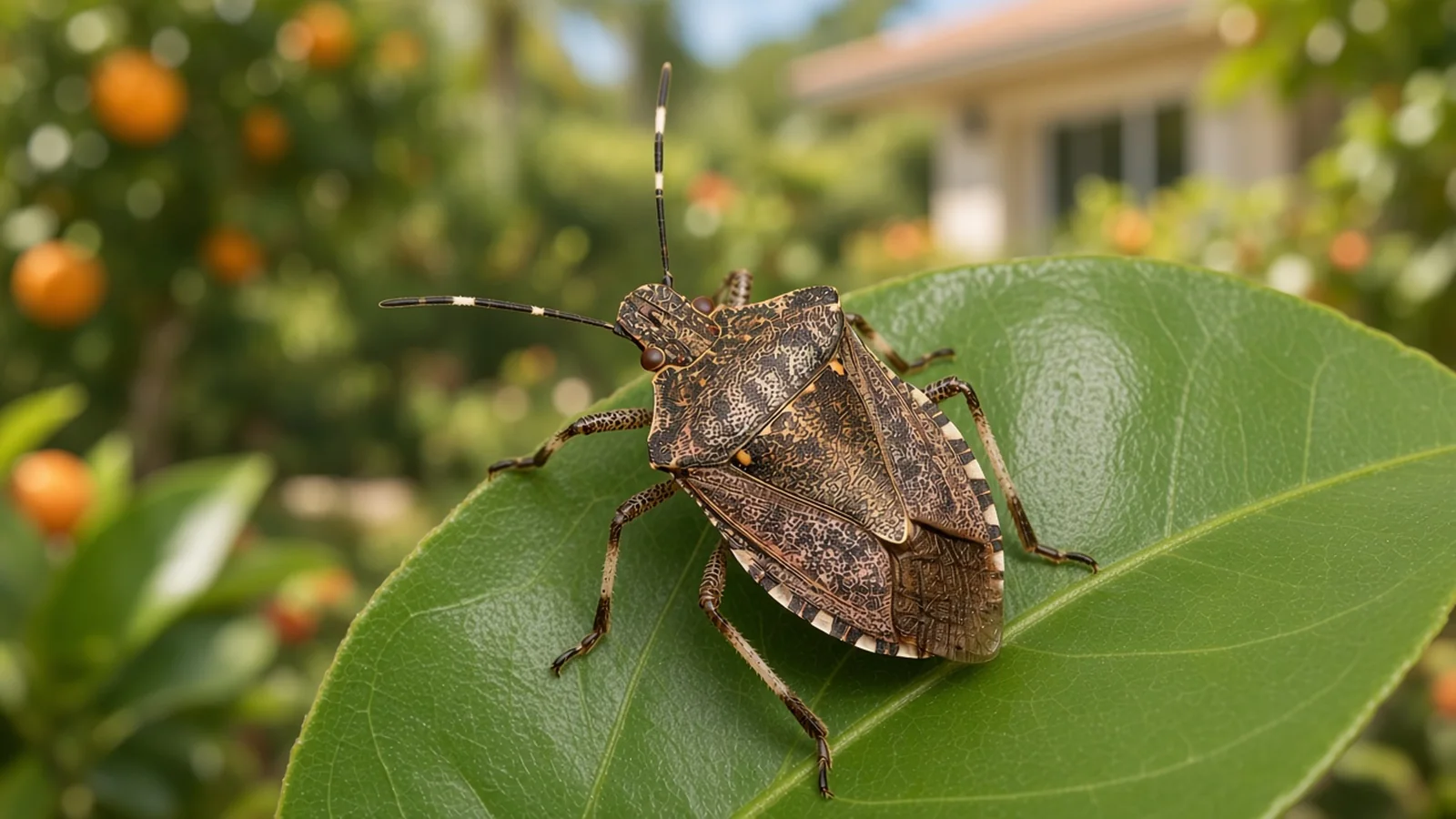
Florida is native stink bug country. The southern green stink bug prefers tomato, pepper and bean pods; the brown stink bug is a generalist on crops and gardens; and the green stink bug overlaps both on woody plants and ornamentals. The invasive brown marmorated stink bug has been spreading into the Southeast and shows up in Florida gardens and farms as well. The antenna cue still works for the invader: alternating light-and-dark bands on the segments, against mostly plain antennae on the native brown species. A shield-shaped bug with banded antennae is more likely the invader; a green shield is almost certainly a native.
University of Florida IFAS splits that picture by species. Its southern green stink bug profile places Nezara viridula in the Southeast from Virginia to Florida, most prevalent from October through December and again from March through April, with up to four generations a year in warm climates. Fruit punctures become hard brownish or black spots that lower market value, and the profile points to Florida insect management guides for tomatoes, peppers, eggplant, and okra. Its brown marmorated profile is narrower: movement into the Southeast has been slow, most Florida reports since 2006 were single hitchhikers, and the only confirmed established population it describes was in a Lake County peach orchard in 2018. That profile also names the brown stink bug, Euschistus servus, as a Florida species that causes catfacing. Adults of the invader are 12 to 17 mm long with white bands on the antennae.
What stink bugs do to Florida vegetables
Tomato and pepper are the classic targets. Stink bugs pierce green fruit with their mouthparts and feed on the developing seed area, leaving a white or corky scarred patch that sinks as the fruit ripens. Home gardeners usually notice it at harvest — a few scarred spots on an otherwise fine tomato. The fruit is safe to eat once the scarred patch is cut away; the same conclusion the tomato guide reaches applies in Florida. In the citrus groves, occasional fruit damage shows up as sunken rind patches that can invite decay, but this is a secondary pest concern compared with the true citrus pests.
The Florida calendar: spring crops, fall walls
Spring (March-May): watch the underside of new tomato and pepper leaves for egg rows and nymph clusters; knock them into soapy water before they spread over the garden. June-September: adult feeding pressure on fruit as it ripens; pick fruit promptly and inspect before eating. Fall (October-November): cooling nights trigger the home-side behavior — adults aggregate on sunny walls and slip through gaps around windows, doors, soffits and utility lines. Winter (December-February): in south Florida activity can continue on warm days; in north Florida it slows to near zero until spring.
Keeping them out of a Florida home
Exclusion carries the season here as everywhere, with a Florida twist: humidity and heat age exterior caulk and seals faster, so inspect them every spring rather than every few years. Caulk gaps where siding meets window frames, under door thresholds, around soffit vents and where pipes or cables enter the wall. Repair torn screen mesh — a common entry point in Florida homes. When a bug does get in, vacuum it with a nozzle and empty the bag outside; crushing it indoors just releases the characteristic odor into your house.
Our recommended picks
As an Amazon Associate, we earn from qualifying purchases. Links below are affiliate links marked as sponsored — a qualifying purchase may earn us a commission at no extra cost to you.
Silicone caulk for gaps
Seal windows, doors and soffit gaps before Florida fall pressure builds.
Screen repair kit
Fix torn door and window screens that let stink bugs drift in.
Vacuum with crevice nozzle
Remove indoor stragglers without crushing and releasing the odor.
More guides
Frequently asked questions
Are stink bugs active in Florida all year?
In central and south Florida, yes: temperatures rarely stay cold enough to stop them, so stink bugs can breed and feed through much of the winter. In north Florida, activity drops during the coldest weeks but picks up again in early spring, which means the state follows a two-peak pattern rather than the single fall push people see up north.
Which stink bug species are common in Florida?
Florida hosts mostly native species — southern green stink bug, brown stink bug and the green stink bug — plus the invasive brown marmorated stink bug spreading in from the north. Agriculture reports show the biggest farm damage from the southern green and brown species on tomato, pepper, soybean and citrus.
Why do stink bugs suddenly appear in my Florida house in winter?
On the first cold snaps, adult stink bugs look for sheltered spots, and houses supply them: attic gaps, door thresholds, window seals and soffit vents. In Florida, the invasion window is shorter and milder than up north, but the behavior is the same — they are looking for a dry place to wait out the cool stretch, not to breed inside.
Do stink bugs damage Florida citrus?
They can. Stink bugs are documented on citrus as occasional fruit feeders, leaving sunken or scarred rind patches that can open the fruit to decay. The bigger Florida loss comes from vegetables — tomato, pepper and bean pods scored by the same shield-shaped pests. Home orchards can manage small losses by checking fruit before canning, since the scarred area is cosmetic once cut away.
How do I keep stink bugs out of a Florida home?
The same exclusion plan that works elsewhere applies here: caulk gaps around windows, doors and utility lines; repair torn screens; and seal soffit vents. Florida humidity makes water-damaged wood and loose trim more likely, so a spring walk-around looking for gaps pays off before the fall invasion pressure starts.
Sources
Last updated: . These guides have no named author and no expert reviewer. The notes say what each page actually supports.
- University of Florida IFAS: Southern green stink bug (EENY-016) — The southern green stink bug is established in the Southeast from Virginia to Florida. It is most prevalent from October through December and again from March through April, and warm climates can have up to four generations a year. Fruit punctures become hard brownish or black spots and lower market value. The profile gives a soybean threshold and points to Florida insect management guides for tomatoes, peppers, eggplant, and okra.
- University of Florida IFAS: Brown marmorated stink bug (EENY-346) — Brown marmorated stink bug adults are 12 to 17 mm long, with white bands on the antennae, and they use buildings as overwintering sites. IFAS says movement into the Southeast has been slow: most Florida reports since 2006 were single hitchhikers, and the only confirmed established population it describes was found in a Lake County peach orchard in 2018. The brown stink bug, Euschistus servus, is named as another Florida species that causes catfacing. Warmer climates can have several generations; most of the North American range has one or two.
- Penn State Extension: Brown marmorated stink bug — For the bugs that do get into a house, sealing cracks and repairing screens is the preferred control, and a vacuum removes the ones already inside. They do not reproduce indoors.
- StopBMSB.org: State-by-state detections — The national map tracks where brown marmorated stink bug is a crop pest and where it is a household nuisance.