Stink Bugs in Michigan: Real vs Native Look-Alikes
Michigan gets both kinds of stink bug problem: the invasive brown marmorated stink bug that storms houses every fall, and the native brown look-alikes that make people report phantom infestations. This is the identification guide first, the control plan second — which is exactly the order Michigan residents need it in.
TL;DR
- Michigan has invasive brown marmorated stink bugs and native brown species that look similar.
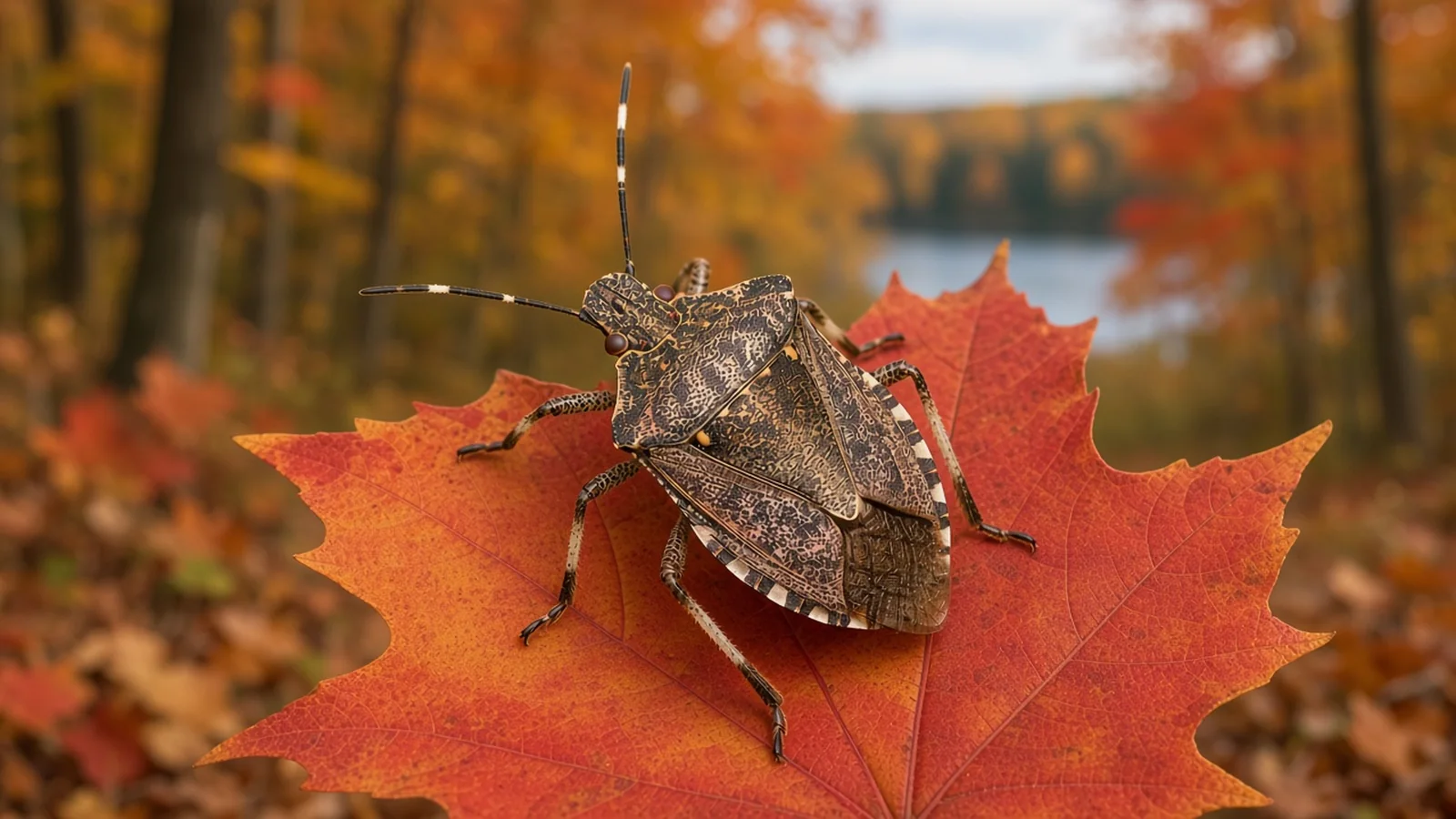
- Identification cues per MSU Extension: banded antennae, smooth shoulder edge, pale abdominal banding.
- Fall invasions peak September-October; control is exclusion: caulk, screens, weatherstripping.
- Unsure? MSU Plant & Pest Diagnostics in East Lansing identifies specimens you mail in.
Why Michigan has an identification problem
By the time the brown marmorated stink bug reached Michigan orchards around 2010-2011, the state already lived with native brown stink bugs — the rough stink bug and several others — that share the shield shape, the size and even the odor gland. MSU Extension published an identification guide for growers specifically because the natives kept getting reported as the invader. Home gardeners fall into the same confusion, so check the details before declaring war.
MSU Extension identification cues
The characteristics MSU lists that set the brown marmorated stink bug apart from Michigan natives:
- Antennae: alternating white and dark bands on the segments. Most native species have plain-colored antennae.
- Shoulder edge (pronotum): smooth and rounded on the invader; the rough stink bug has a visibly toothed edge.
- Abdomen edge: a pale banding pattern of alternating light-dark where the abdomen meets the wing.
- Underside: the invader is mottled gray-brown on the belly, not golden or brick.
Size is not the answer — Michigan stink bugs of every species hover around half an inch to an inch. If you cannot get close enough to see bands and edges, photograph a few bugs against white paper and use the diagnostic pipeline below instead of guessing.
The reporting line that helps the state
MSU Extension asks residents who suspect a new infestation to collect a few specimens and send them to MSU Plant & Pest Diagnostics, 101 Integrated Plant Systems, East Lansing, MI 48824. That is not a formality: county-level spread maps are built from these submissions, and a mail-in from Berrien or Leelanau can flag a county the state was not watching. A ziplock with a coin-sized piece of apple or leaf as cushioning survives the post.
The Michigan year: a single generation, one big move
Michigan brown marmorated stink bugs run one generation per year, like their Ohio and Wisconsin neighbors — eggs from mid-summer, nymphs through August, new adults from late summer. The behavior that makes them famous happens on the first cool-warm day swings of September: aggregation on the sunny south and west walls of houses, then entry through siding gaps, soffit vents, window frames and pipe penetrations. Inside, they do not breed, bite or damage structure — they wait out winter and come back to life on warm January days.
Control that matches the calendar
July-August: garden-side pressure — check the underside of tomato and bean leaves for egg rows and knock them into soapy water (full method in the tomato guide). September, before the first invasion: exclusion. Caulk every gap around windows, doors, siding and utility pipes with silicone or silicone-latex caulk, repair screens, seal where dryer vents and cable lines enter. October-February: vacuum with a nozzle, seal the bag outside; crushing indoor bugs just moves the smell into your carpet.
Perimeter sprays are a second-line option in Michigan the same as everywhere else: a labeled residual spray around entry points in late summer gives partial help, but exclusion carries the season.
Our recommended picks
As an Amazon Associate, we earn from qualifying purchases. Links below are affiliate links marked as sponsored — a qualifying purchase may earn us a commission at no extra cost to you.
Exterior-grade silicone caulk
Seal the soffit, siding and pipe gaps they use from September onward.
Screen repair patch kit
Fix the torn window and dryer vents that serve as open doors.
Vacuum with crevice nozzle
Remove winter clusters without releasing the smell.
More guides
Frequently asked questions
Are the stink bugs in Michigan the invasive kind?
Many of them, yes — but not all. Michigan home gardens and houses also host native brown species (the rough stink bug and others) that are easy to mistake for the invasive brown marmorated stink bug. MSU Extension built an identification guide specifically because growers kept sending in the natives. The fall house-invasion behavior, though, is classic brown marmorated stink bug.
How do you tell a brown marmorated stink bug from a native one?
MSU Extension points to three cues: alternating light-and-dark bands on the antenna segments (most natives have plain antennae), a smooth shoulder edge on the back plate versus the toothed edge of the rough stink bug, and the pale banding along the abdominal edge. Size alone is not reliable — many Michigan stink bugs land in the same half-to-three-quarter-inch range.
When did stink bugs arrive in Michigan?
Brown marmorated stink bug spread into Michigan orchards and vineyards around 2010-2011; MSU Extension issued grower-facing identification warnings for the 2011 season. Since then it has become a regular nuisance pest, with peak home invasions each September and October.
Who do I send an unidentified stink bug to in Michigan?
MSU Extension recommends collecting a few specimens and mailing them to MSU Plant & Pest Diagnostics at 101 Integrated Plant Systems, East Lansing, MI. Before fall numbers explode, that submission line is how the state tracks new counties. A clear macro photo on white paper helps the diagnosticians.
Do stink bugs hurt Michigan apples and cherries?
They can — tart cherry, apple, peach and grape are among the documented hosts, and home tomato and bean patches get the same scarred-patch damage described in our tomato guide. Orchards manage them with threshold scouting; a few brown scars on your backyard fruit are cosmetic, and the fruit is safe once the patch is cut away.
Sources
Last updated: . These guides have no named author and no expert reviewer. The notes say what each page actually supports.
- NC State Extension: Brown marmorated stink bug — Whitish bands on the antennae separate brown marmorated stink bug from native brown, dusky, and rough stink bugs, which lack those bands. The rough stink bug also has a flatter body.
- University of Maryland Extension: Brown marmorated stink bug FAQ — The last two antennal segments have alternating light and dark bands, and the exposed edge of the abdomen is banded the same way.
- StopBMSB.org: Stink bug basics — Look-alikes called out by the project include the native brown stink bug, the dusky stink bug, and the spined soldier bug.
- Penn State Extension: Brown marmorated stink bug — In fall the bugs gather on sun-warmed walls and get in through gaps. Sealing those gaps is the preferred home control.
- StopBMSB.org: State-by-state detections — Detections are tracked state by state, as both a crop problem and a nuisance in buildings.