Stink Bug vs Kissing Bug: 5 Differences That Matter
Most people who search this comparison are worried about the same thing: is the bug on my wall dangerous? For a stink bug the answer is no. For a kissing bug it is more serious — kissing bugs feed on blood, and the CDC links them to Chagas disease. Shape, head and behaviour separate them in seconds.
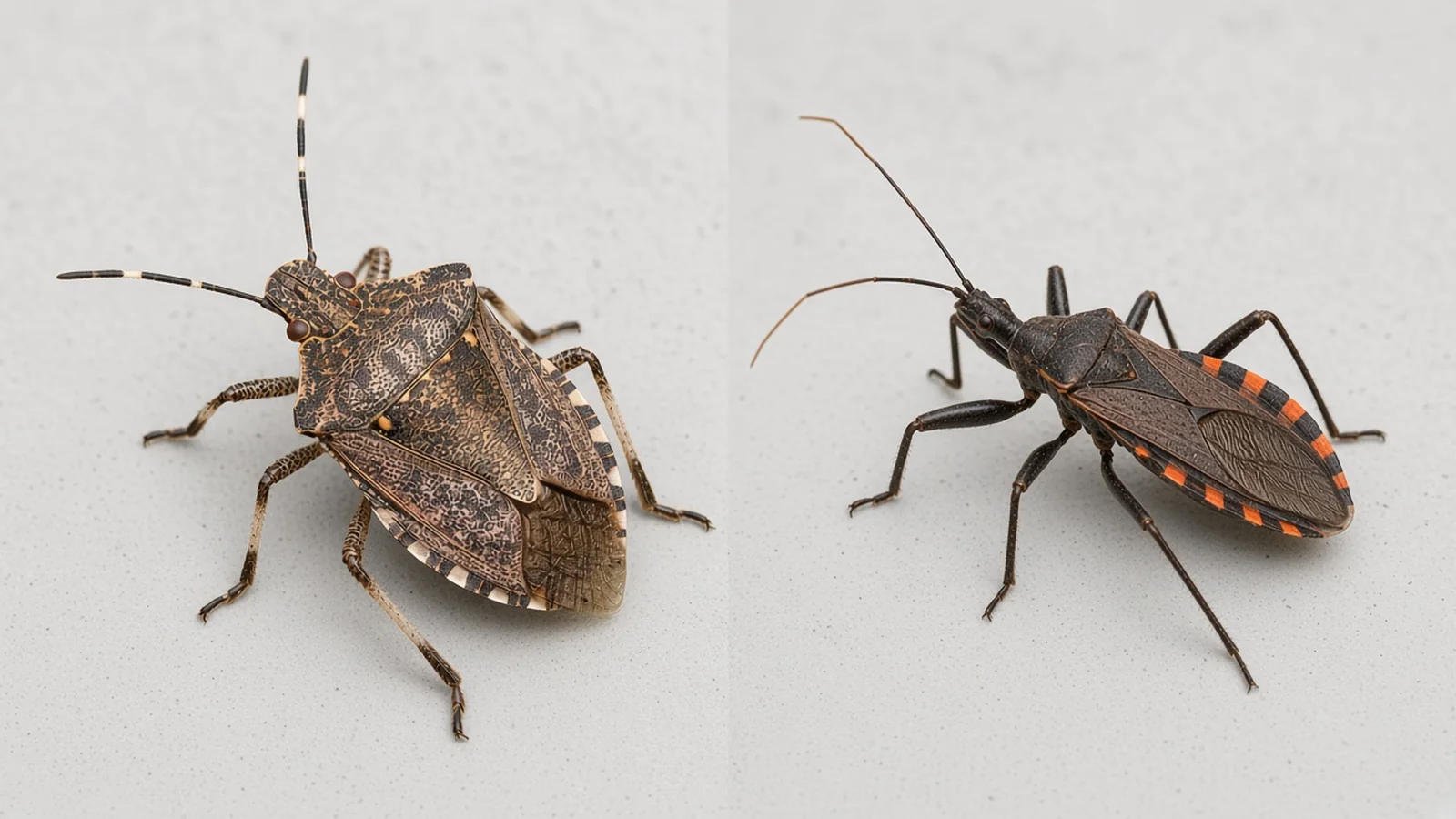
TL;DR
- Stink bug: shield-shaped, flat top tapering to a point, plant feeder, harmless to people.
- Kissing bug: cone-shaped head, wider abdomen with sides that flare out, blood feeder.
- Kissing bugs bite, usually at night, often on the face — hence the name. Stink bugs cannot bite at all.
- Kissing bugs can carry the parasite behind Chagas disease and spread it through their droppings, not the bite itself.
- If you find a kissing bug indoors, do not handle it barehanded — put it in a container and contact your local extension office.
The comparison in one table
| Feature | Stink bug (BMSB) | Kissing bug (triatomine) |
|---|---|---|
| Body shape | Shield: flat across the shoulders, tapering to a point | Elongated oval, sides of the abdomen flare wider than the wings |
| Head | Short and blunt, tucked into the shield | Long, narrow, cone-shaped |
| Diet | Plant sap — fruit, pods, leaves | Blood of mammals and birds |
| Bites people? | No | Yes, usually at night |
| Smell when disturbed | Strong, cilantro-like | None |
| Where you meet it | Walls, curtains and windows in fall | Under porches, in dog houses, rodent nests, woodpiles |
1. The shape is the quickest test
A brown marmorated stink bug is almost as wide as it is long, with a flat shoulder line and a pointed rear, and adults run about 17 mm long according to Penn State Extension. The kissing bug is longer and narrower, and its wings lie flat over an abdomen whose edges stick out on both sides. If the bug looks like a small brown shield, it is a stink bug.
2. Look at the head
The cone-nose is the giveaway. Kissing bugs belong to the assassin bug family and have a long, thin, tapered head. A stink bug’s head is short and wide and disappears into the front of the shield. You do not need a magnifier for this — photograph it with your phone and zoom.
3. What it eats decides everything else
A stink bug’s beak is a sap straw. It works on fruit, pods and stems, and Ohio State University Extension lists 175 host plants in the US, from apples and peaches to soybeans and ornamental maples. A kissing bug’s beak is built to pierce skin and take blood. Nothing in a stink bug’s anatomy is set up to bite a person, which is why the most harm a stink bug does is a bad smell and a possible allergic reaction.
4. Kissing bugs and Chagas disease
The CDC describes Chagas disease as an infection caused by the parasite Trypanosoma cruzi, carried by triatomine bugs. The important detail most people get wrong: the infection spreads mainly through the bug’s droppings, which get rubbed into the bite site, the eye or a scratch — not through the bite itself. The CDC estimates about 280,000 people in the United States have Chagas disease, most of whom were infected elsewhere in the Americas, and says the disease is present in the US but not regularly spread by triatomine bugs here.
That is the honest framing. Finding a kissing bug on your porch is not an emergency, but it is also not a stink bug you can flick outside. Wash your hands, keep the bug in a sealed container, and let your county extension office or health department identify it.
5. Where each one turns up at home
Stink bugs arrive in autumn, gather on warm south- and west-facing walls, and slip through window frames and fascia gaps to spend the winter. Kissing bugs are not seasonal invaders of living rooms; they live near the animals they feed on — under porches and concrete, in dog houses, chicken coops, woodpiles and pack rat nests. A bug on your bedroom wall in October is a stink bug with near certainty; a bug in the dog house is worth a second look.
If the bug in your house is not a stink bug but also not a kissing bug, the other common confusion is bed bugs — a comparison with a very different action list.
More guides
Frequently asked questions
Is a kissing bug the same as a stink bug?
No. They are in different families. Kissing bugs are blood-feeding assassin bugs with a cone-shaped head; stink bugs are plant-feeding shield bugs that cannot bite people.
Can a stink bug bite me?
No. Its mouthparts are made to pierce plant tissue. Crushing one against skin can irritate the skin, but that is a chemical reaction to the defensive spray, not a bite.
How do I know if it is a kissing bug?
Long cone-shaped head, wings lying flat over an abdomen with edges sticking out on both sides, no smell when disturbed. Photograph it and send it to your county extension office if you are unsure.
Do kissing bugs carry disease in the US?
They can carry the parasite that causes Chagas disease. The CDC says the disease is present in the US but not regularly spread by triatomine bugs here, and that transmission mainly happens through contact with bug droppings.
What should I do with a kissing bug I find?
Do not handle it with bare hands. Trap it in a container, wash your hands afterwards, and contact your local extension office or health department for identification.