Stink Bugs in Ohio: Counties, Seasons and Control
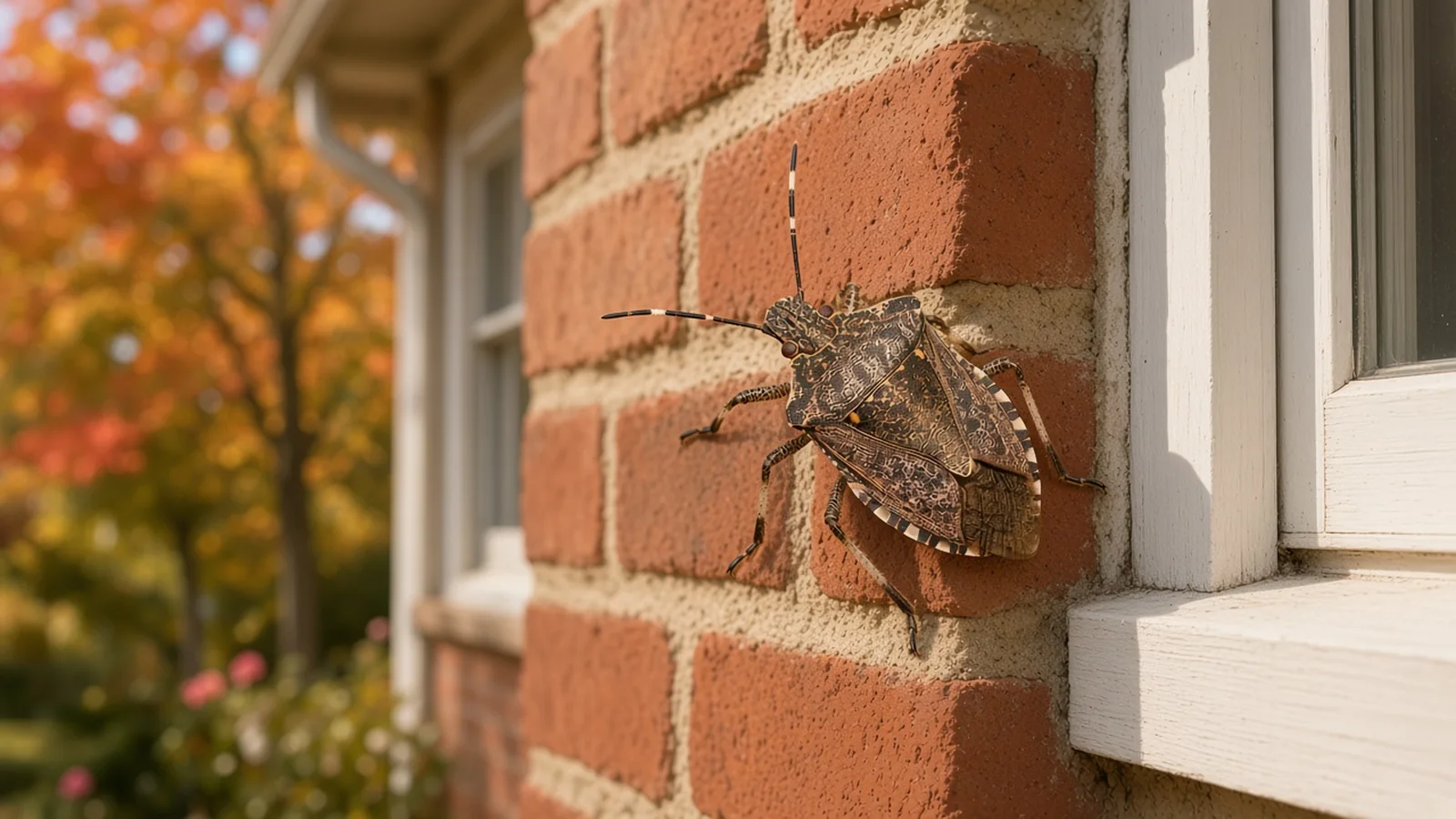
Ohio's stink bug is the brown marmorated stink bug, documented here since December 2007 and now recorded in 62 of 88 counties. This page is the Ohio-specific version: what the state fact sheet actually says, what the bugs damage in an Ohio garden, and the autumn control window.
TL;DR
- First Ohio record: December 2007, Franklin County. Now in 62 of 88 counties (OSU Extension).
- Density is patchy — high in some areas, low in many — and the bug hitchhikes between cities.
- 175 reported host plants in the US; in Ohio that means apples, peaches, sweet corn, tomatoes, peppers and soybeans.
- Indoors: vacuum and a light-jar trap. OSU Extension advises against indoor insecticide.
Ohio's record: one county in 2007, 62 counties since
The state fact sheet (Ohioline ENT-90, Ohio State University Extension) gives the timeline plainly: the brown marmorated stink bug was first documented in Ohio in December 2007, in Franklin County. Since then it has been documented in 62 of Ohio's 88 counties, and the authors add that it likely can be found in all of them.
For context on how it got here at all: the species was first identified in the United States in 2001 from a specimen collected in 1998 in Allentown, Pennsylvania, and by 2020 it had spread to 46 states and four Canadian provinces. Ohio's 2007 record is part of that expansion, not a separate introduction.
The fact sheet also explains the patchiness you may see between neighbouring counties: the bug is a well-known hitchhiker in cargo, cars, trucks, planes and railcars, moving city to city and establishing quickly where it lands. That is why populations appear in jumps rather than spreading outward evenly — and why "my county is not on the list" is not a reason to relax.
Where the pressure actually is
The Extension fact sheet does not rank Ohio counties by population, and any page that gives you a numbered county list is working from something other than the state sheet. What it says instead is that as of 2020 the bug is present at high density in crops and buildings in some areas of Ohio, and at low density in many others.
Practically, that means the local picture is set by three things rather than by geography alone: whether there is a crop host nearby (sweet corn, soybean, apple, peach, pepper, tomato), whether the buildings are old enough to have gaps, and whether the bug has already established in your town. Two houses on the same street can have very different autumns.
What they damage in Ohio gardens and fields
The fact sheet counts 175 reported host plants in the United States — effectively "almost any crop that has fruit or immature seeds" — and it moves between hosts through the season, from early-ripening fruit to late-ripening fruit. In Ohio terms, the damage looks like this:
- Apples and pears. Discoloured irregular depressions on the surface, dark or dark-edged, with light brown pithy tissue under the skin — often mistaken for cork spot.
- Peaches. Dark blotches with gummosis or cat-facing when the damage is early; water-soaked-looking lesions with corky white flesh underneath when it is late.
- Sweet corn. Kernels sucked dry through the husk, shrinking irregularly — similar to dented corn, but uneven.
- Tomatoes and peppers. Cloudy spots on the surface with thick white corky tissue underneath, which makes fruit unusable for processing.
- Green beans and soybeans. Light green splotches and necrotic spots on pods, with secondary infections following.
The garden version of this — cloudy spots, what is still safe to eat, and plant-safe options — is on the tomato plants guide. The fact sheet's point about feeding is worth keeping in mind: the beak is longer than most stink bugs' and strong enough to reach through bark, which is why ornamental trees are on the host list too.
The Ohio autumn window: what to do, and when
The indoor problem is an autumn problem. As crops and ornamentals finish, adults leave the plants and look for somewhere to spend the winter; buildings are the substitute for the rock crevices and dead trees they would use in their native range. The practical order of work:
- Late August to early September: seal. Caulk gaps around window frames, door frames, utility penetrations and soffits; add door sweeps and repair screens. This is the only step that stops the supply.
- Through September and October: watch the sunny south and west walls. Aggregations on siding on a warm afternoon are the warning that the bugs have found your house.
- October onwards: remove what gets in. Vacuum with a crevice tool or use the light-and-jar method below, and keep an eye on window wells and the corners of rooms that face the afternoon sun.
- Warm days in winter and early spring: stragglers wake up and appear at windows. They are harmless, and they are the last of the season rather than a new invasion.
The full step-by-step is on how to get rid of stink bugs, and the winter behaviour is explained on stink bugs in the house in winter.
Indoor control: what Ohio State Extension actually recommends
This is the part where the state sheet is unusually direct, and it is worth quoting the substance rather than paraphrasing it into something stronger:
- Vacuum. Live and dead bugs can be removed with a vacuum cleaner or shop vac; the bag should be removed and discarded promptly. Promptly matters — a bag left in the machine is where the smell concentrates.
- Light and a jar. Because the bugs are attracted to light, turning on a single light in a dark room lets you collect them in a jar or bottle as they come to it.
- Dispose outdoors or in sealed trash. Either is fine; what you are avoiding is crushing them indoors, which is the smell the species is named for.
- No indoor insecticide. The fact sheet states that insecticides should not be used inside houses after the insects have gained access, because it does not stop additional invasions and it exposes people and pets to pesticides.
For traps you can build from a lamp, a pan or a shop vac, see stink bug trap DIY. They do not reproduce indoors and cause no structural damage — the reassurance every extension office repeats, including this one.
Our recommended picks
As an Amazon Associate, we earn from qualifying purchases. Links below are affiliate links marked as sponsored — a qualifying purchase may earn us a commission at no extra cost to you.
Exterior silicone caulk
The step that decides whether the autumn gathering becomes an indoor one.
Weatherstripping and door sweeps
For the moving joints caulk cannot handle — doors, garage doors, sliding frames.
Handheld vacuum with crevice tool
Extension-endorsed indoor removal: bag out and discarded right after.
More guides
Frequently asked questions
Are stink bugs a problem in Ohio?
Yes. The brown marmorated stink bug was first documented in Ohio in December 2007 in Franklin County, and Ohio State University Extension reports it has since been documented in 62 of the state's 88 counties — with the likelihood that it can be found in all of them. Since 2020 it has been at high density in crops and buildings in some parts of the state and low density in many others.
Which Ohio counties have the most stink bugs?
The Extension fact sheet does not rank counties. What it does say is that density varies sharply by area — high in some, low in many — and that the bug travels as a hitchhiker in cars, trucks, planes and railcars, which is how new populations appear city by city rather than spreading out evenly from a single point.
When do stink bugs come inside in Ohio?
The autumn movement is the one that matters: as nights cool, adults leave crops and ornamental plants and gather on the sunny sides of buildings, then work into gaps around windows, soffits, siding and utility penetrations. Once inside they are overwintering, not breeding.
Do stink bugs damage Ohio crops?
They do, and the Extension fact sheet lists the damage crop by crop: discoloured depressions in apples, corky white flesh under cloudy spots on tomatoes, shrivelled kernels in sweet corn, blotches and cat-facing on peaches, and mottled pods on green beans. The US host list runs to 175 plants, so almost any crop with fruit or immature seed is at risk.
Should I spray insecticide indoors for stink bugs in Ohio?
Ohio State Extension is explicit that insecticides should not be used inside houses after the bugs have gained access: it does not stop further invasions and it exposes people and pets. The endorsed indoor tools are a vacuum (remove and discard the bag promptly) and a light with a jar, because the bugs come to the light.
Who do I contact about stink bugs in Ohio?
Your county Ohio State University Extension office is the local source for crop and household pest questions, and the Ohioline fact sheet ENT-90 is the state fact sheet behind most of the advice on this page. For commercial growers, the OSU Agronomic Crops Network publishes seasonal field reports.
Sources
Last updated: . These guides have no named author and no expert reviewer. The notes say what each page actually supports.
- Ohio State University Extension (Ohioline ENT-90): Brown marmorated stink bug — The brown marmorated stink bug was first documented in Ohio in December 2007 in Franklin County, and has since been documented in 62 of Ohio's 88 counties, with the likelihood it can be found in all of them. It was first identified in the United States in 2001 from a specimen collected in 1998 in Allentown, Pennsylvania, and by 2020 had spread to 46 states and four Canadian provinces. There are 175 reported host plants in the United States, and almost any crop with fruit or immature seed is at risk. As of 2020 it can be found at high density in crops and buildings in some areas of Ohio and at low density in many others. Live and dead bugs can be removed from buildings with a vacuum cleaner, and the bag should be removed and discarded promptly; because the bugs are attracted to light, a single light in a room allows them to be collected in a jar. Insecticides should not be used inside houses after the insects have gained access.
- Penn State Extension: Brown marmorated stink bug — They do not reproduce inside structures and do not cause structural damage.