Stink bug trap DIY: five traps you can build with what you have
Most stink bug traps are a light, a container and a drop of dish soap. Which one to build depends on whether the bugs are flying at a window or hiding in a wall — and every one of them catches stragglers, not the colony.
TL;DR
- Bugs inside: vacuum them up without crushing them. Put liquid in the machine only if its manufacturer permits wet pickup; keep an ordinary dry vacuum dry.
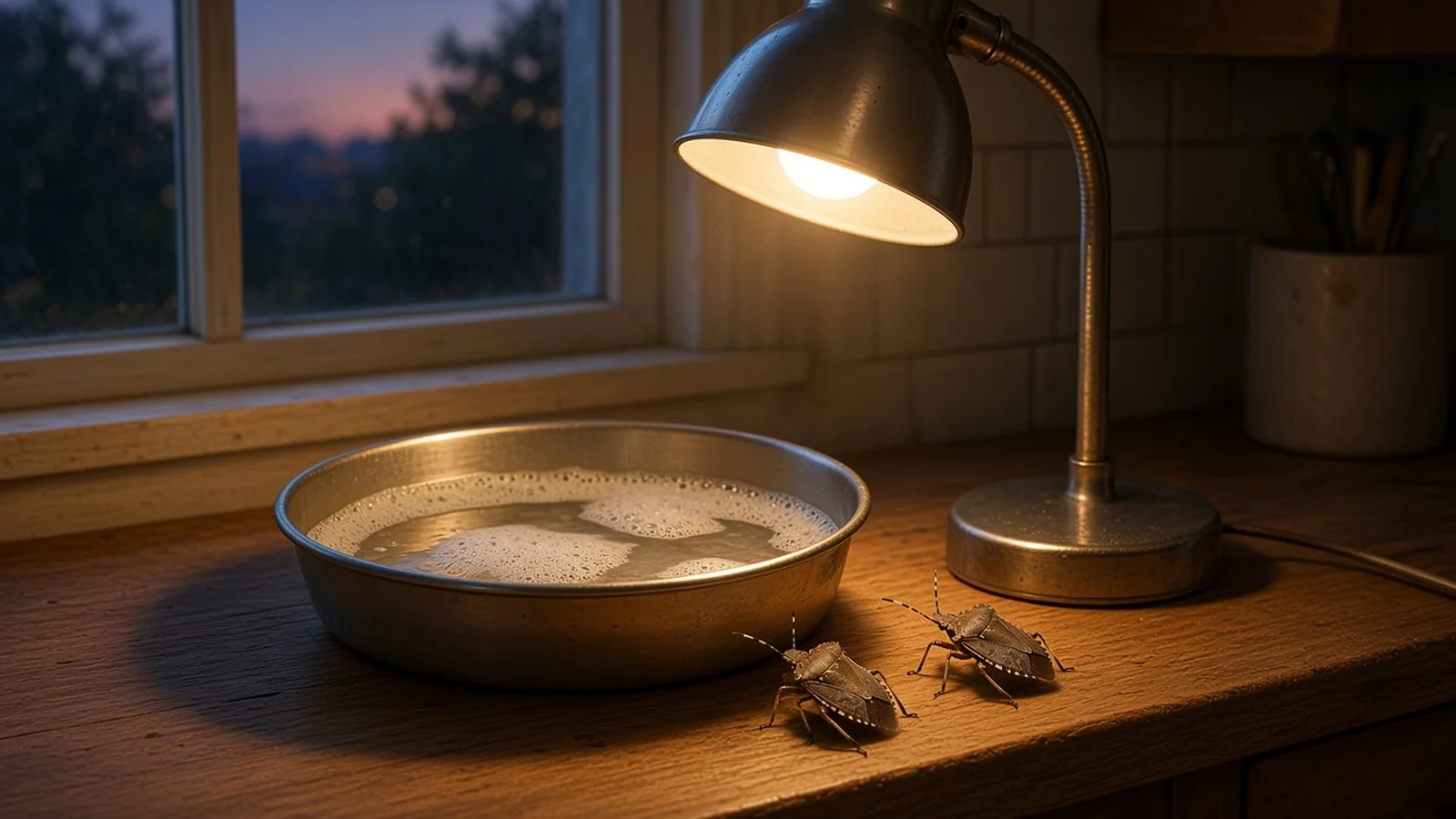
- Bugs at a window at night: desk lamp over a shallow pan of soapy water, room dark.
- Bugs looking for winter shelter: folded cardboard in the attic, emptied every few days.
- All three catch what is loose. The permanent fix is sealing the gaps — that is a different page.
Why DIY traps work on this insect at all
A stink bug is a shield-shaped true bug that feeds on plants in summer and, from late summer into fall, looks for somewhere warm and dry to spend the winter. That shift is what makes it trappable: for six weeks a year it is actively moving toward buildings, light and warmth, and it collects in tight spaces in numbers. Traps work on that behaviour, not on hunger — there is no bait that brings them from across a yard.
Two physical facts do most of the work in a homemade trap. First, the bug is a strong walker and a mediocre flyer, so it turns up in sill corners, screens and window wells rather than in mid-air. Second, dish soap breaks water's surface tension: a stink bug can float or stand on plain water for a while, but in soapy water it cannot, and it sinks.
What traps do not do is stop the supply. If hundreds are coming out of a wall void each warm afternoon, every trap you build is a bucket in a leaking room — which is why the removal playbook on how to get rid of stink bugs puts sealing first and trapping second.
Trap 1 — the lamp and pan (catches the ones that fly)
The oldest stovetop-potpourri-era trick in the book, and it still works because stink bugs come to light at night.
- What you need: a shallow pan or tray with an inch of water, a few drops of plain dish soap, and a lamp you can put directly above it — a desk lamp, a clamp lamp or a phone torch taped to a stand.
- Setup: room dark, lamp on, pan directly beneath the light with the water covering the bottom. Put it near the window where you have been finding them, not in the middle of the floor.
- Why it works: the lamp is the brightest thing in a dark room, so bugs flying and walking toward the light end up at the rim, then in the water.
- Catch rate: best in the early evening of a warm fall day, when bugs are active. In a lit room, or in mid-winter when the indoor population is mostly stationary, expect almost nothing.
Keep the lamp away from curtains and anything flammable, and empty the pan each morning. A dead stink bug in water does not smell, but a pan left for a week does.
Trap 2 — the wet/dry shop vac with soapy water (catches the ones hiding)
This is the one to build if you are finding bugs on ceilings, walls and behind blinds and want them gone tonight.
- What you need: a wet/dry shop vacuum whose manufacturer permits wet pickup. Add water or dish soap only as allowed by that model's manual; do not use this setup in a dry-only vacuum.
- Setup: use the crevice tool, not the wide floor nozzle, and work slowly along the frame of windows and doors. Suction takes them off surfaces without crushing them.
- Why the water matters: in a dry vac the bugs stay alive inside the hose and bucket and can crawl back out; the soapy layer drowns them and stops the smell from building up in the filter.
- Afterwards: empty the bucket outside, and do not open the vacuum indoors afterwards — the tank is the one place the smell concentrates.
A household dry vacuum can pick up the bugs dry, but must not be used to collect water or soapy liquid. Use water only with a wet/dry model whose manufacturer permits it, following that model's wet-pickup instructions. The smell can remain in a dry vacuum bag. If you only have a household vac, vacuum into a sock or a stocking over the nozzle and drop the whole thing into a bucket of soapy water. The detailed version of this method is on the natural removal page.
Trap 3 — folded cardboard in the attic and garage
This is a shelter trap rather than a bait trap, and it is the one most people skip because it is boring: you are imitating the place stink bugs already want to be.
- What you need: corrugated cardboard, cut into panels and folded accordion-style, or a few flattened boxes stacked loosely with gaps between the layers.
- Where: attics, garages, crawl spaces, behind siding, in the gap between a screen and a window — anywhere cool, dry and undisturbed.
- Why it works: bugs that come in through soffits and vents settle in tight folds in numbers. A folded cardboard panel is that fold, offered on purpose.
- The catch: you have to check it. Every two or three days, take the panel outside, shake the bugs into a bucket of soapy water, and put it back. A cardboard trap left unchecked for a month is a nursery.
Do not use this around food storage or anywhere damp — wet cardboard grows mould, and a wet shelter trap attracts nothing but silverfish.
Trap 4 — sticky bands on the window frame
Low effort, low yield, but useful for windows that act as a funnel. Put double-sided tape or a strip of sticky trap along the sill and up the frame where you keep finding bugs. It catches the ones that walk the frame, which is most of them at a window, and it tells you which window is the entry point — that information is worth more than the catch.
Change the strips when they are covered, and keep them out of reach of pets and small children. Glue traps catch beneficial insects too, so outdoors they are a last resort.
Trap 5 — the bucket on the porch, for the fall migration
For the two or three weeks when bugs are landing on the south and west walls in the afternoon, a bucket trap outside the door intercepts them before they find a gap.
- What you need: a bucket, water, dish soap, and something bright or warm at the top — a solar path light or a lamp on an extension cord.
- Setup: place it against the wall where bugs are congregating, light on at dusk, water and soap at the bottom.
- Why: warm, sunny walls are where they land and climb; anything that makes the bucket the brightest nearby object during the evening gets you a share of them.
- Limit: it catches what walks to it. It will not reduce a population coming out of a wall void on the other side of the house.
Traps that are a waste of money
- Foggers and bug bombs. They do not reach wall voids, where the population actually is, and they leave a residue on everything in the room.
- Ultrasonic plug-ins. No published evidence that they repel this species, and a lot of people buy them twice.
- Bait stations. Baits are built around feeding, and stink bugs in a house are not feeding — they are hibernating.
- Any trap marketed as a permanent fix. Traps catch what is loose. The supply comes from outside, and the fix for that is on the removal page.
If you have already tried sprays and they did not hold, the reason is usually that spraying kills the ones you can see while the ones in the wall keep coming — the comparison on what sprays actually do is worth reading before buying another can.
Our recommended picks
As an Amazon Associate, we earn from qualifying purchases. Links below are affiliate links marked as sponsored — a qualifying purchase may earn us a commission at no extra cost to you.
Wet/dry shop vacuum
For indoor removal, use a wet/dry shop vac according to its manual. Put soapy water in the tank only if the manufacturer permits that setup; keep dry-only vacuums dry.
Sticky window traps
Flat, unscented glue strips for sills and window corners — no water, no daily emptying.
Folding cardboard panels
For shelter traps in attics and garages: stink bugs overwinter in folds like these.
More guides
Frequently asked questions
What is the best DIY stink bug trap?
For bugs already indoors, a vacuum can remove them without crushing each one by hand, although the vacuum may retain their smell. Keep a dry-only vacuum dry. Use liquid in a wet/dry shop vac only if its manufacturer permits it, following that model's instructions. A separate shallow pan of soapy water under a desk lamp is another trap option; do not pour it into a dry vacuum.
Does a soapy water trap actually work on stink bugs?
It works on the bugs that land in it. Dish soap breaks the surface tension of water so they cannot stand on it, and they sink within seconds. What it does not do is attract them — the light or the trap baits them, the water finishes the job.
Will a light trap work indoors?
Only in a dark room. A lamp over a pan works when the room is otherwise dark and the bugs are active, which for stink bugs means a warm afternoon or early evening in the fall. In a lit room the lamp is not the brightest thing they can see and the catch drops sharply.
Do cardboard box traps catch stink bugs?
Cardboard works as a shelter trap rather than a bait trap: stink bugs looking for a place to spend the winter crawl into gaps and folds, so a folded box or a corrugated band placed in an attic, garage or behind siding collects them. Check and empty it into soapy water every few days, or you have built them a home.
Are store-bought stink bug traps better than DIY?
Different jobs. Sticky window traps and light-baited indoor traps are tidier than a pan of water and catch stragglers without daily attention. A DIY soapy-water trap catches more per dollar and handles a sudden wave in one evening. Neither replaces sealing the gaps they use to get in — see the entry-point guide.
What should I do with the stink bugs after catching them?
Drown them in soapy water and empty the bucket outside, or bag the contents and put them in the bin. Do not crush them indoors: the smell is the defence mechanism that gives the species its name, and it lingers on hands, cloth and the vacuum hose.